RECOVER - Day 1
⬇️ WATCH DAY ONE ZOOM CALL ⬇️
PHASE ONE
During these first 7 days, you will begin to alter your nutrition, slowly removing foods like red meat and refined items that put stress on your digestive system and can tilt your body toward a more acidic state. You’ll also be introduced to three of the five supplements that make up this Ayurvedic program—Everyday Greens, CCF, Himalayan Salt, and your Dosha Digest.
Because most of us are living in a slightly dehydrated state, in Week One, you’ll begin to properly hydrate your body, which is critical for optimal cellular function. Along with hydration, the Week One meal plan will provide you with the vital nutrition needed to help maintain the body’s alkaline/acid balance, and give your digestive system a break.
Once your system has been primed, balanced, and nourished, it will be ready to continue the detoxification process.
WATER
Water helps regulate your body temperature, lubricate your joints and muscles, flush waste from your cells, cleanse your internal organs, balance fluids, and eliminate toxins from your bloodstream. In short, it’s essential for all life. Without it, we’d die.
Drink plenty of Mineralized distilled water to help your body during its detoxification process and to minimize minor or temporary headaches and body aches that may arise. If you have any persistent or severe headaches or body aches, please consult your physician.
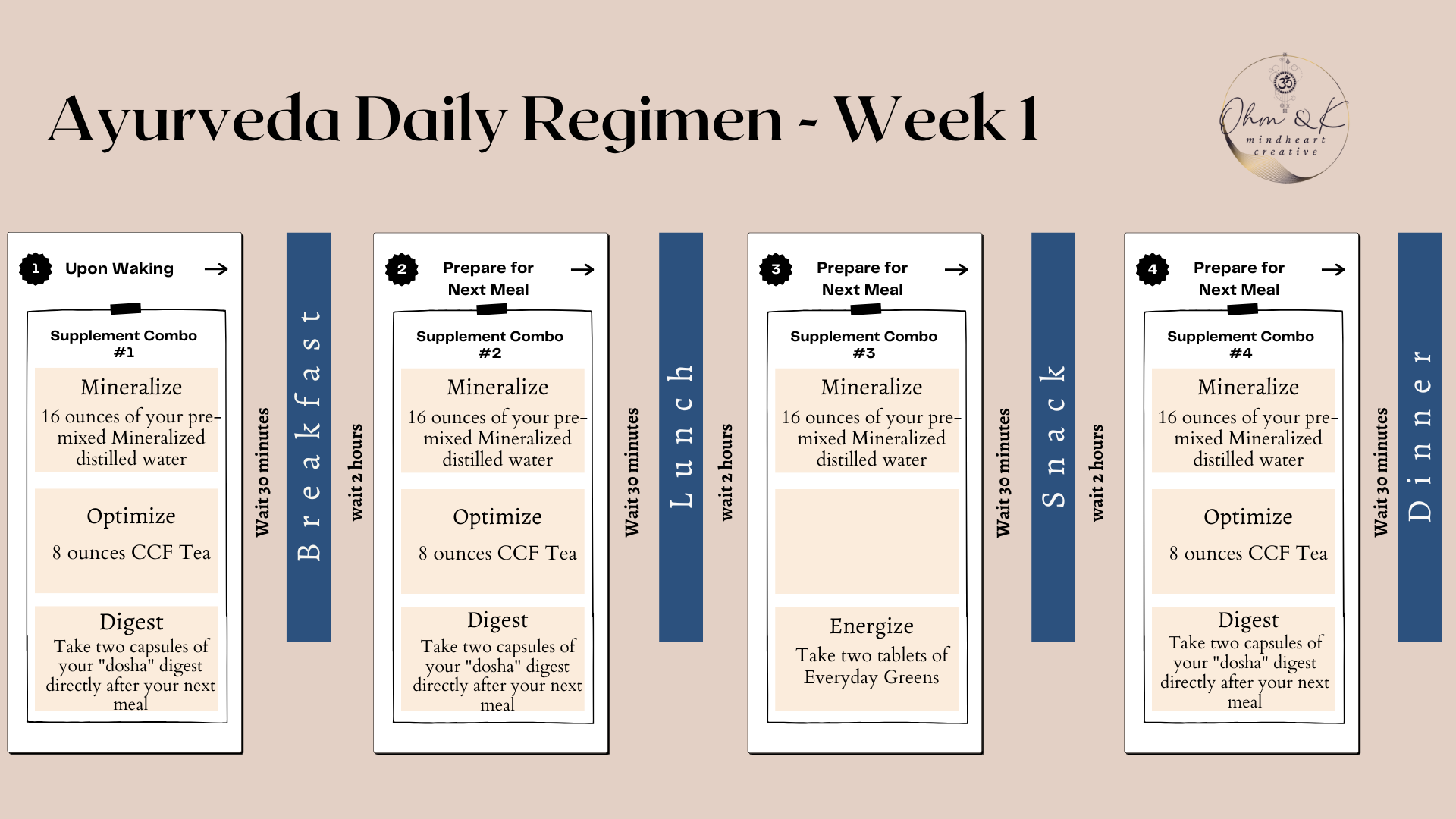
Since hydration is a major part of the health equation, it’s also a major part of the Ayurveda Reset. During the next 21 days, you’ll drink a great deal of distilled water with Pink Himalayan Salt (PHS) added to it. Distilled water is a highly purified source of water and is the preferred choice for cleansing. Adding PHS to it will supply you with essential minerals and electrolytes (sodium and chloride) your body needs for optimum health.
During your program you will be using distilled water (with added PHS) wherever “water” is called for. Besides the 12 to 24 ounces you drink with your supplements, we recommend you drink additional “Mineralized” distilled water throughout your day. (To help calculate your water intake and to make sure you get enough water, take your weight in pounds, divide by two, and drink that many ounces of water each day—for example, if you weigh 160 pounds, try to drink 80 ounces of water a day.) You should stay well ahead of dehydration, and never allow yourself to feel too thirsty.
During your Reset, we encourage you to drink an 8- to 12-ounce glass of Mineralized distilled water 5 to 10 minutes BEFORE your meals, instead of drinking during meals. This will probably be a big shift. If you understand the reasoning, it may be easier to make the change.
Drinking liquid while you eat tends to dilute digestive juices and acids, which slows down your digestion considerably. When food takes too long to go through your system, it can cause digestive problems. In addition, drinking water prior to a meal curbs your appetite and dulls hunger pangs. Water also prepares, opens, cleans, and lubricates the digestive tract, getting your body primed and ready for the food to come.
For ease of use, we recommend that you add 1/4 tsp. of PHS directly to your gallon of distilled water and pour from that throughout your day.
Worried that you won’t be able to swallow your food without drinking? Another new practice you’ll be learning is to chew each mouthful of food longer and more thoroughly. Aim for 20 to 30 chews before swallowing. Ideally, your food should be nearly liquid in consistency before you swallow it, so not having a glass of liquid to wash it down with won’t be a problem. You may begin drinking Mineralized distilled water 30 minutes after your meal.
MINERALIZE MIXING INSTRUCTIONS
Add 1/4 teaspoon of Himalayan salt per gallon of distilled water, or a pinch (1/16 teaspoon or roughly the amount of salt that fits between your thumb and forefinger) to each 12- to 24-ounce glass of distilled water.
Soaking Grains & Nuts
First, why is soaking so important?!
Nuts, seeds, and grains have things in them called phytic acid and enzyme inhibitors. These are helpful in that they help prevent them from germinating before they're in the proper environment, however, they're not so helpful when we eat them. They bind with minerals and prevent us from digesting them and absorbing all the goodness they have to offer. This can cause nutrient deficiencies and digestive irritation for some people (bloat, the runs, lower belly pain, cramps etc.). They essentially pass through the way they went in... hello visuals!!
Soaking raw nuts, seeds, and grains helps to activate the sprouting process and makes the minerals, vitamins, fats, and proteins (all the good stuff!) more available to us and better absorbed.
What comes after soaking?
They can be made into nut milk by using 1 cup soaked nuts per 4 cups water and blending well in a high-speed blender for a few minutes, then strained through a nut milk bag, a cheese cloth, or thin tea towel.
Soaked grains are rinsed well and then eaten raw, by blending into smoothie bowls or buckwheat pudding, and can also be cooked according to the recipe. Soaking grains greatly reduces the cooking time as well!
What about roasting nuts and seeds?
Roasting nuts and seeds without soaking them first means the phytic acid and enzyme inhibitors are still there, so I would limit but not necessarily eliminate these type of nuts! Sometimes, I crave the toasty flavor of roasted nuts and nut butter. If you soak and then roast your nuts/seeds, they will no longer be raw, but because you soaked them, the phytic acid will be reduced, so that's great! I would recommend roasting at a lower high heat, like 250°F so that the outsides don't get crispy before the insides are done. You don't want a mushy centre! Stir occasionally and check at the 2 hour mark.
Truly "raw" nuts
Most cashews are not truly raw, even if they are labelled raw, as they need to be heat treated in order to be separated from their fruit. These will not sprout as the enzymes have been destroyed. However soaking is still beneficial for reducing phytic acid.
Almost all almonds grown in the States are "pasteurized" with steam or a chemical wash, which destroys the enzymes within them, making them no longer raw and no longer able to germinate/sprout. I've actually only ever had one batch of soaked almonds start sprouting after 12 hours of soaking, which meant they were truly raw. These were organic raw almonds from Central Roast. Tip, this is why almonds are labelled "natural" almonds, not organic or raw almonds (even in health stores!)
Is soaking nuts/seeds/grains for everyone?
Our digestive systems are designed to handle phytic acid in small amounts, but some people are more sensitive than others and certain diets are more prone to issues with phytic acid. If you can't do this extra step, it's not the end of the world. Seriously!
If you eat lots of nuts/seeds and foods high in phytic acid like grains, legumes, nut flours/butters, and beans (usually those that eat plant-based diets) we encourage you to at least try and and see if it helps you! Sometimes we don't know that something isn't right or that we can actually feel better until we try something different. Plus, they are honestly so delicious you may find it hard to eat non-soaked nuts anymore!
Weekly Prep Tips
You can make these items ahead of time to cut down on prep time. Do it on a “cook day” before you begin Phase 1 or even the night before if you have the time:
Lentil-Lime Salad Please note, this salad needs to marinate for 2 hours before serving. For convenience, you can also assemble this salad on your cook day or the night before serving
Baked Tempeh, Please note, tempeh needs to marinate for 1 hour before baking. For convenience, you can also assemble this dish on your cook day or the night before serving.
Zucchini-Cashew Soup, Please note, cashews must first be soaked for 1 hour before you begin making the soup. For convenience, you can soak cashews in the morning before cooking.
Helpful Tips for Phase 1 – RECOVER See the Shopping List for Phase 1 for all of the items you’ll need to purchase for the week.
Greek Dressing, Good for Weeks One and Two.
Salad Dressing
Toasted Pumpkin Seeds
Miso Soup, Store this in a tightly sealed container in the refrigerator.
Brown Rice,
Quinoa,
Nori Gomasio
Lentils
Menu Day One
Breakfast
1 slice whole-grain toast;
2 scrambled eggs, prepared with 1 tsp. extra-virgin olive oil;
and 1 1/2 cups steamed kale or spinach.
Note: Faster metabolism? add a second slice of toast and increase steamed kale to 2 cups.
Vegan Breakfast Option: Coconut Quinoa. Note: Men may have an additional 2 Tbsp. chopped walnuts and an additional 1/4 medium papaya.
Lunch
Miso Soup;
Microgreen Salad;
1/3 cup Toasted Pumpkin Seeds; and 1 serving dressing of choice from recipe guide.
Note: Faster metabolism? increase Toasted Pumpkin Seeds in salad.
Dinner
Baked Salmon;
1½ cups steamed asparagus with lemon juice and 1 tsp. extra-virgin olive oil; and 1 cup boiled baby potatoes (with skin).
Note: Faster metabolism? use 2 tsp. extra-virgin olive oil on asparagus.
Vegan Dinner Option: Baked Tempeh (pg. 81); 1½ cups steamed asparagus with lemon juice and 1 tsp. extra virgin olive oil; and 1 cup boiled baby potatoes (with skin). Note: Men may use 2 tsp. extra-virgin olive oil on asparagus.
Food Prep Tip: If your schedule’s tight, prepare the baked salmon in the morning and let it marinate in the refrigerator while you’re out for the day. It’ll be ready to put in the oven when you get home.
SNACK IDEAS
Green apple + 15 raw almonds ½ cup
Cooked Quinoa + 1/ 3 medium avocado
1 to 2 cups raw veggies (carrots, broccoli, cauliflower, pea pods, bell peppers, etc.) + ¼ cup hummus OR ¾ cup organic plain yogurt
1 medium green apple + 1 tbsp. organic almond butter 1 hard-boiled egg + 6 to 10 whole-grain crackers (100 calories total for crackers)
1 cup raspberries + ¾ cup plain organic yogurt sprinkled with cinnamon
1 cup shelled organic edamame 3 celery stalks + 2 Tbsp. organic almond butter
Recipes
Coconut Quinoa (vegan breakfast option) (Makes 1 serving)
3/ 4 cup cooked quinoa (see recipe below), warmed
2 tbsp. canned coconut milk, warmed
1 tsp. pure maple syrup
1/ 4 cup fresh pineapple chunks
1 Tbsp. chopped raw walnuts
Combine warm quinoa, coconut milk, and maple syrup; mix well. Place in serving bowl; top with pineapple and walnuts.
Baked Salmon (Makes 1 serving)
1 clove garlic, chopped
2 tsp. olive oil
1 tbsp . chopped fresh basil
1/4 tsp. Himalayan salt
1/2 tsp. herbal seasoning blend
1 tbsp. fresh lemon juice
1 tbsp. chopped fresh parsley
1 (6-oz.) salmon fillet, wild-caught
Combine garlic, oil, basil, salt, seasoning blend, lemon juice, and parsley in a small bowl; mix well. Place salmon in a shallow dish; pour marinade over salmon. Marinate for 20 min, turning once to get marinade on both sides. Preheat oven to 350° F. Place salmon on a piece of aluminum foil. Cover with marinade; seal. Place sealed salmon on baking sheet. Bake 20 min, or until salmon flakes easily when tested with a fork.
Miso Soup (Makes 1 serving)
2 cups water
1 tbsp. miso paste, mixed with 2 to 3 tbsp. hot water
2 tbsp. dried wakame seaweed
1 green onion, sliced thinly
Bring water to a boil in a small saucepan over medium heat. Turn off heat. Add miso paste, seaweed, and green onion. Let sit for 3 to 5 minutes; stir. Serve hot.
Quinoa (Makes 4 servings, 1 cup each)
1 cup dry quinoa
2 cups cold water
Rinse quinoa thoroughly. Combine quinoa and water in small saucepan; place over high heat and bring to a boil. Reduce heat to maintain a gentle boil; cook, covered, for 20 to 25 minutes, or until all water has been absorbed. Remove pan from heat and let quinoa sit, covered, for 10 minutes without lifting or removing lid. Fluff with a fork and serve.
Baked Tempeh (Makes 1 serving)
2 tbsp . apple cider vinegar
2 tbsp. Bragg Liquid Aminos
11/2 tsp. sesame oil
11/2 tsp. pure maple syrup
1/2 clove garlic, chopped
4 oz. tempeh, cut into 1/ 2-inch strips
Combine vinegar, Bragg Liquid Aminos, oil, maple syrup, and garlic in a small bowl; mix well. Place tempeh in a shallow dish; pour marinade over tempeh. Marinate for 1 hour in refrigerator, turning once to get marinade on both sides. Preheat oven to 350° F. Bake for 10 to 15 minutes on each side.
Microgreen Salad (Makes 1 serving)
In most produce sections, you can find bulk or bagged mixed baby greens, which may include lettuces, baby kale, mizuna, radicchio, etc. These are perfect.
Dress salad using one (or all) of the dressing recipes in the salad dressing section
3 c ups baby salad greens
1/4 medium carrot, shredded
1/2 medium cucumber, chopped
1/2 medium red bell pepper, sliced
1/4 cup sprouts (like radish, alfalfa, or broccoli)
1/2 medium tomato, chopped
1/4 cup chopped jicama
1 tbsp. fresh chopped cilantro (optional)
Combine greens, carrot, cucumber, bell pepper, sprouts, tomato, jicama, and cilantro (if desired) in a large bowl; toss gently to blend.
Salad Dressing Recipes
Ginger-Sesame-Miso Dressing (Makes 8 servings, about 2 Tbsp. each)
2 Tbsp. miso paste
1/4 cup rice vinegar
1 tbsp. Bragg Liquid Aminos
1/4 cup sesame oil
1 tsp. chopped ginger
1/4 cup water
Place miso, vinegar, Bragg Liquid Aminos, oil, ginger, and water in a blender or food processor; cover with lid. Blend until smooth. Store in airtight container in refrigerator.
Creamy Garlic Dressing (Makes 10 servings, about 2 Tbsp. each)
1/2 cup extra-virgin olive oil
1/4 cup apple cider vinegar
3 cloves garlic, crushed
3 tbsp. fresh lemon juice
2 tbsp . chopped fresh parsley
1 tsp. Himalayan salt
1/2 tsp. Dijon mustard
1 tbsp. raw honey (or pure maple syrup)
Place oil, vinegar, garlic, lemon juice, parsley, salt, mustard, and honey in a blender or food processor; cover with lid. Blend until smooth. Refrigerate dressing if not using immediately. If dressing solidifies when cold, hold at room temperature for 30 minutes. Stir before serving.
Basic Vinaigrette (Makes 8 servings, about 2 Tbsp. each)
1/2 cup extra-virgin olive oil
1/4 cup red wine vinegar
1 tsp. Himalayan salt
1 tsp. raw honey (or pure maple syrup)
2 tbsp. fresh lemon juice
2 tsp. chopped fresh herbs (like basil, oregano, parsley, or dill) (to taste; optional)
Place oil, vinegar, salt, honey, lemon juice, and herbs (if desired) in small bowl; mix well.